Automated Screen Cutting Machine Retrofit
The Challenge
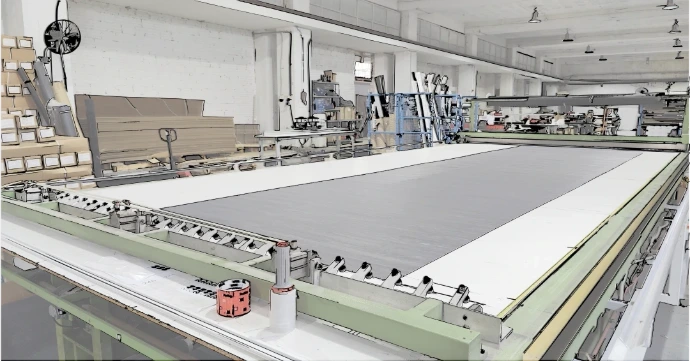
Our client operated a large-format screen cutting machine that had been the backbone of their production for years. While the mechanical structure remained robust, the control system had become a critical bottleneck:
- Outdated electronics with limited diagnostic capabilities
- Inconsistent cutting accuracy requiring frequent manual intervention
- Difficult maintenance due to obsolete components no longer in production
- Limited operator interface with no recipe management or production data
- Safety concerns lacking modern emergency stop and interlock systems
Replacing the entire machine would have required a significant capital investment with long lead times. The client needed a smarter solution.
Our Solution
We designed and delivered a complete retrofit of the control and automation system while preserving the proven mechanical structure. The new system delivers the precision and reliability of a brand-new machine at a fraction of the cost.
How the Machine Works (Post-Retrofit)
The cutting cycle operates in four precisely coordinated stages:
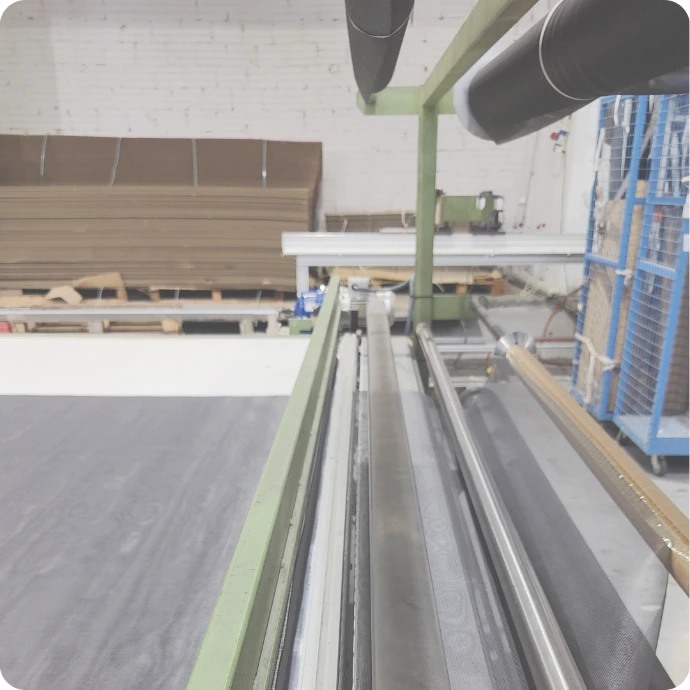
- Pickup — The motorised gantry approaches the screen and engages it using pneumatic grippers
- Measurement — As the gantry traverses along the machine, an incremental encoder continuously tracks position with sub-millimeter accuracy, calculating the exact cut location
- Cutting — At the target position, the pneumatically actuated blade engages and cleanly cuts the screen material
- Stacking — The gantry returns at controlled speed, releasing the cut piece to stack neatly on top of the previous one — producing a perfectly aligned bundle ready for packaging
Technical Implementation
Control & Automation Hardware
| Component | Brand / Model | Function |
|---|---|---|
| PLC | Siemens S7-1200 + Expansion I/O | Main controller, sequence logic, axis control |
| HMI | Weintek Touch Panel | Operator interface, recipe management, diagnostics |
| VFD | Control Techniques Commander C | Gantry motor speed control |
| Position Feedback | Incremental Encoder | Real-time gantry position measurement |
| Industrial Gateway | Mikrotik | Remote access, data logging, remote diagnostics |
| Power Supply | Mean Well NDR-120-24 | Industrial-grade 24V DC supply |
| Circuit Protection | Schneider Electric Acti9 | MCBs, RCDs, full electrical protection |
| Pneumatic Control | Airtac Valves & Cylinders | Gripper and blade actuation |
| Safety | Emergency Stop circuit | Compliant with modern safety standards |
Custom-Built Control Cabinet
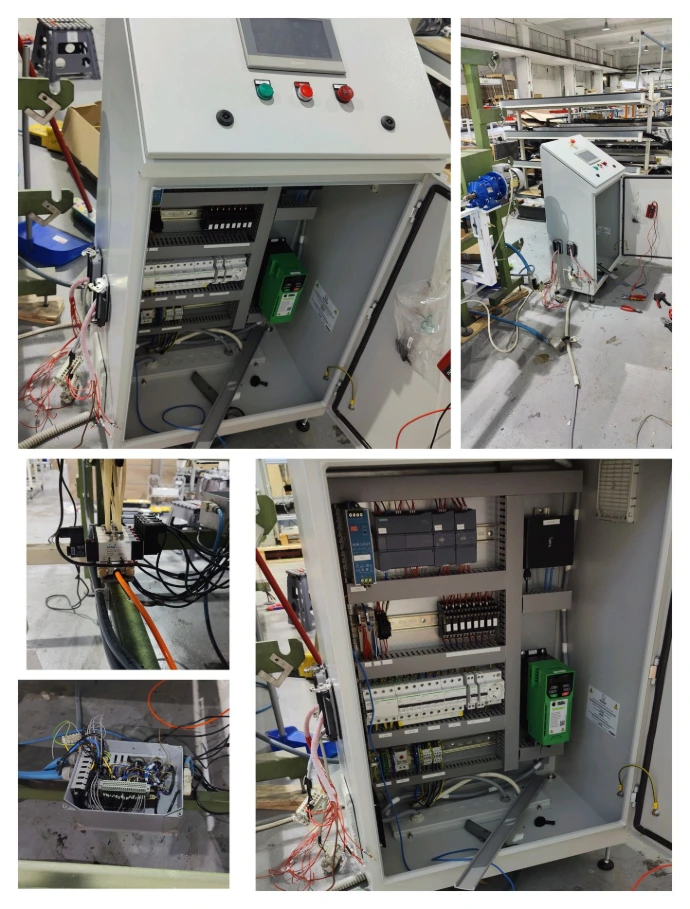
A new IP-rated industrial enclosure was designed and manufactured in-house, featuring:
- Professional cable management with labeled wiring throughout
- Front-mounted HMI with intuitive operator controls (Ready / Start / Alarm indicators)
- Emergency stop button with proper safety circuit integration
- Easy-access internal layout for maintenance
- Climate control with industrial cooling fan
- Properly grounded and EMC-compliant installation
Key Features & Capabilities
Precision & Repeatability
Encoder-based closed-loop positioning ensures every cut is identical, eliminating the variability of the old system.
Recipe Management
Operators can store and recall multiple cutting programs from the HMI — switching between products takes seconds, not minutes.
Diagnostics & Alarm Management
Real-time status monitoring, alarm history, and clear fault descriptions on the HMI dramatically reduce troubleshooting time.
Remote Access
Through the MOXA industrial gateway, our engineers can connect remotely for diagnostics, software updates, and rapid support — minimizing downtime.
Future-Proof Components
All selected components are current-generation models with long-term availability. The client is no longer dependent on obsolete parts.
Modern Safety Compliance
The new system meets contemporary industrial safety standards with proper emergency stop circuits, safety interlocks, and protective relays.
Results & Business Impact
The retrofit delivered measurable improvements across every key metric:
| Metric | Before | After |
|---|---|---|
| Operation Mode | Semi-manual, operator-intensive | Fully automatic |
| Cutting Accuracy | Variable, frequent rework | Sub-millimeter precision |
| Setup Time | Manual recalibration per batch | Recipe recall in seconds |
| Diagnostics | Trial-and-error troubleshooting | Real-time alarm system |
| Spare Parts | Obsolete & hard to source | Current, available components |
| Operator Safety | Outdated safety systems | Modern E-Stop & interlocks |
Why Retrofit Instead of Replacement?
The economics of industrial retrofit are compelling when the mechanical structure is sound:
- Lower capital investment — typically 20-40% of new machine cost
- Faster deployment — weeks instead of months of lead time
- Preserved mechanical reliability — older industrial machines often outlast modern counterparts
- Customised functionality — the new control system is tailored to your exact process
- Same result — a machine that performs like new, with modern features and full support